
Communication Cannot Be Treated as Secure Simply Because It Is Still Available
At Lotus Sirius, we developed and field-verified DDIL PQC AI for operational environments where communication can no longer be assumed to be secure, available or under friendly control.
DDIL PQC AI is not a product update, a software feature or an additional layer added to an existing communication network. It is an independent tactical communication protocol developed for conditions in which connectivity may be absent, denied, monitored, manipulated or operationally unreliable.
The problem is not limited to a complete loss of connectivity.
A communication system may appear to be functioning while its traffic is being monitored, its signal is being located, its data is being intercepted or its operating environment is being manipulated. Satellite links, GPS signals, cellular infrastructure, base stations and central servers may remain technically available while no longer providing a trusted operational communication environment.
The presence of a connection does not, by itself, make communication secure.
Modern defence communications continue to depend on the assumption that networks, satellites, positioning systems, energy infrastructure and central services will remain available throughout a mission. In contested environments, each of these dependencies can be disrupted, denied or placed under adversarial observation.
DDIL PQC AI was developed where those assumptions cease to be reliable.
Our starting point was not to add another software layer to an existing tactical network or to create a conventional alternative radio channel. The question was more fundamental: How can critical data be protected and transmitted when no central authority, satellite or trusted network can be assumed—and when communication itself may be monitored, disrupted or manipulated?
DDIL PQC AI brings together three operational principles within one independent protocol approach: Communication continuity under DDIL conditions Post-quantum cryptographic protection Data transmission independent of a central online authority The protocol was designed to operate without internet, GPS, Bluetooth, external power infrastructure or a central server. Its purpose is not to replace every existing communication system. Its purpose is to provide an independent communication capability for environments in which existing connectivity cannot be treated as a sufficient basis for operational trust.
Field Verification
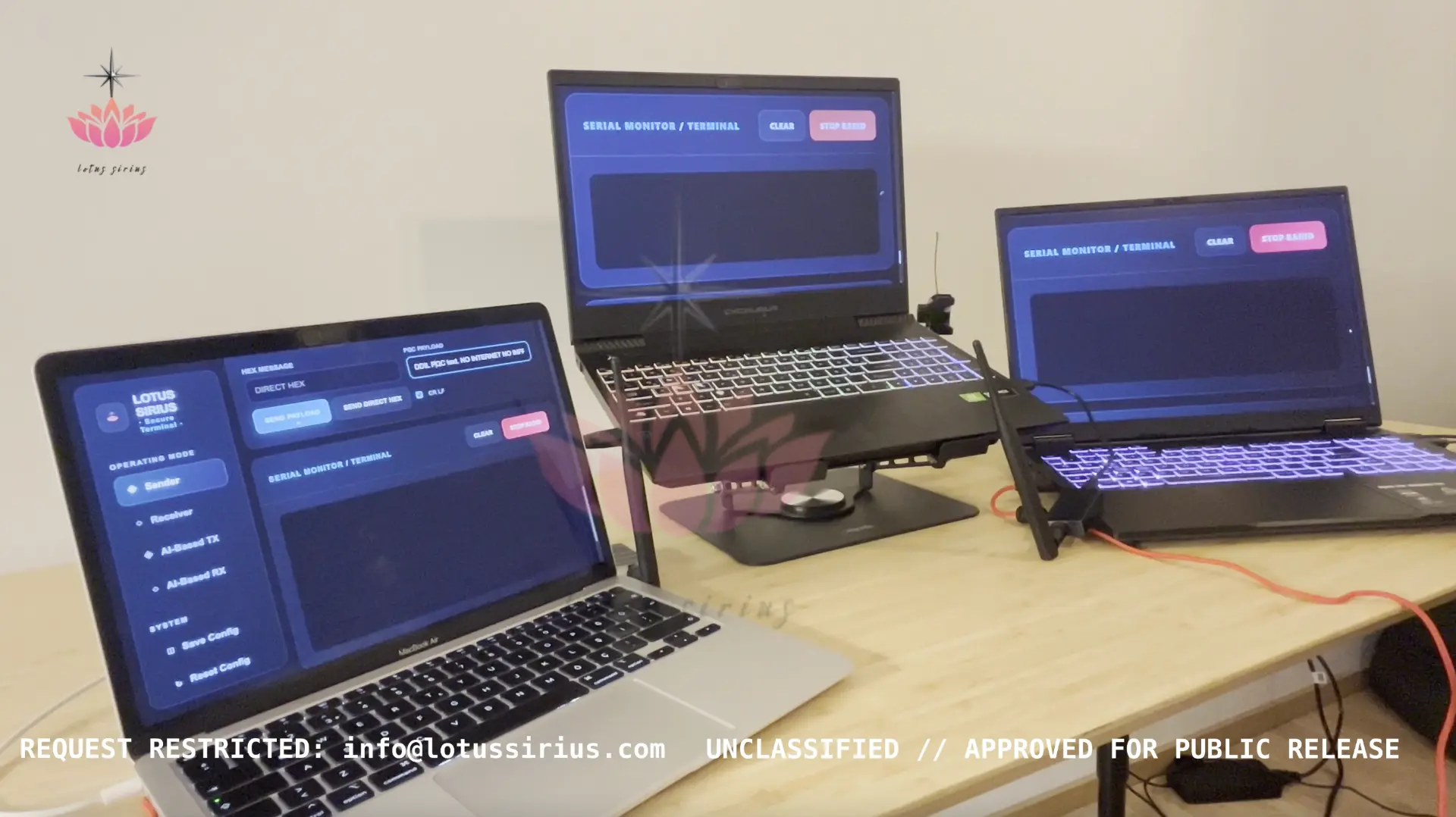
The accompanying field verification documented data transmission between three independent hardware nodes without internet, GPS, Bluetooth, external power infrastructure or a central online authority.
A live unauthorised interception attempt was conducted while the protocol was active. The interception attempt failed.
This was not presented as a concept demonstration. The verification examined whether DDIL PQC AI could maintain its intended communication model when the infrastructure normally supporting communication was unavailable.
The significance of the verification lies not only in the transmission itself, but in the conditions under which it was performed.
A communication capability designed for contested environments must be evaluated precisely where networks, positioning, external power and central services can no longer be assumed.
An Independent Tactical Protocol
DDIL PQC AI is not an add-on feature to an existing communication network, a software update or a conventional alternative radio channel. It is an independent tactical communication protocol developed for environments in which communication security, continuity and control cannot be left entirely to external infrastructure. The protocol brings together: disconnected and infrastructure-independent operation; post-quantum cryptographic protection; decentralised data transmission; autonomous mission capability; a communication model that does not require a central online authority.
Its purpose is not to make an existing network appear more secure. Its purpose is to provide an independent operational foundation for situations in which the network itself, its infrastructure or its trust assumptions may no longer be reliable.
Where Connectivity Cannot Be Assumed
Defence communication is often evaluated under conditions in which networks, power, positioning and supporting infrastructure are functioning as expected.
The more demanding question begins when they are not.
When connectivity is denied, positioning is unavailable, infrastructure is compromised or communication traffic is exposed to adversarial observation, mission continuity depends on more than the existence of a signal. It depends on whether critical data can remain protected and whether communication can continue without relying on a trusted central network.
That is the operational problem DDIL PQC AI was developed to address.
The protocol, software, algorithms and underlying architecture were developed in-house at Lotus Sirius. DDIL PQC AI does not depend on third-party AI models, external runtimes or cloud services for its core operation.
Developed and made in Finland. Built for Europe.
(DDIL PQC AI is built entirely in-house from its software and algorithms to its underlying architecture. It is not dependent on third-party models, external runtimes or cloud services. Made in Finland. Built for Europe. )
Public Disclosure
Lotus Sirius has developed and field-verified DDIL PQC AI as an independent tactical communication protocol for environments in which connectivity, infrastructure and communication security can no longer be assumed. The protocol is now publicly disclosed. Further information will be communicated through appropriate institutional channels. Developed and made in Finland. Built for Europe.