
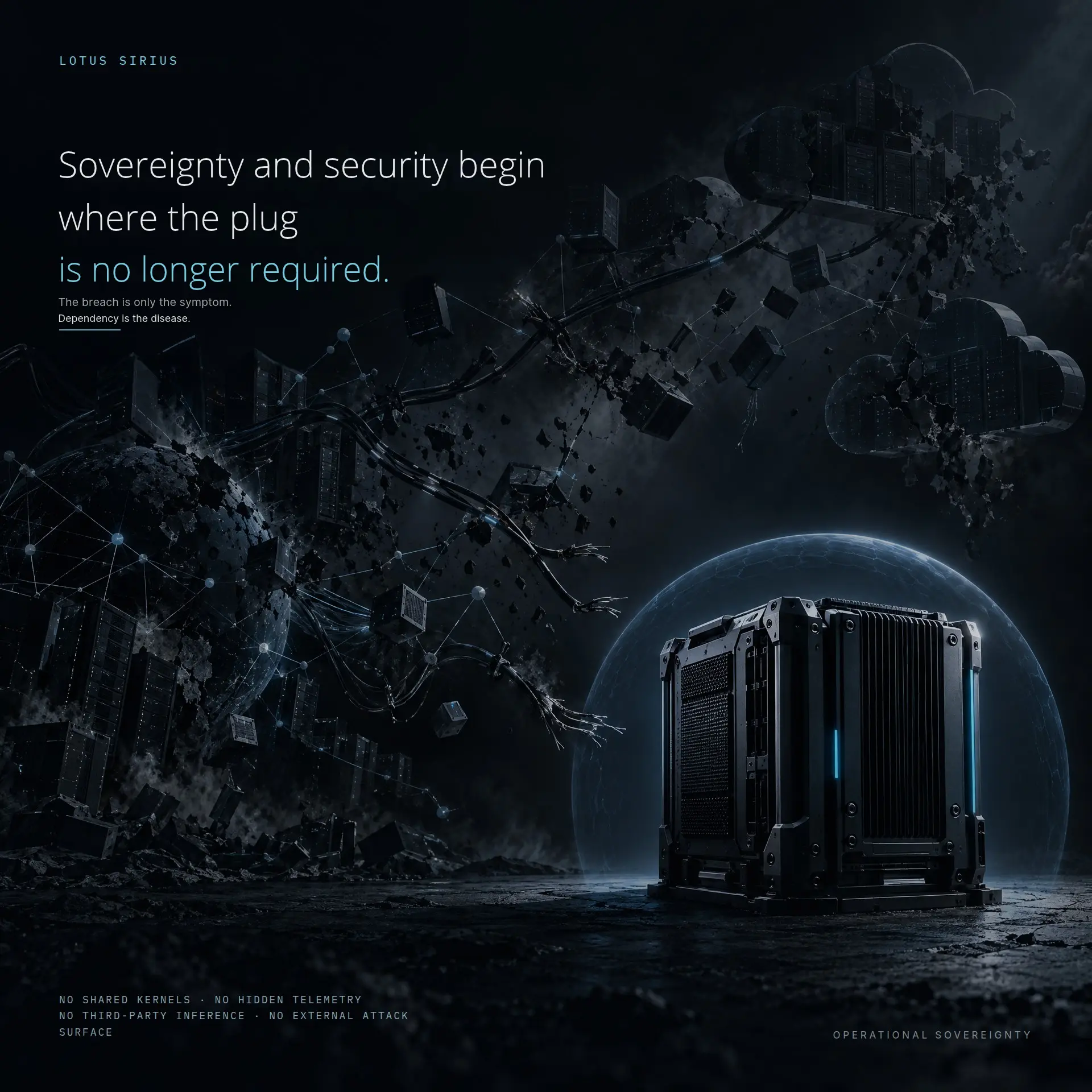
Sovereignty and security begin where the plug is no longer required. The breach is only the symptom. Dependency is the disease.
The Upstream Reality: Beyond Accidental Vulnerabilities The recent cascading failures across global digital infrastructure were not isolated anomalies or standard zero-day incidents. They were triggered by structural flaws in the ubiquitous plumbing of the modern web: an unvetted library in PHP, a critical runtime vulnerability in Node.js and foundational privilege escalation flaws in the Linux kernel.
Yet, routine patching misses the far more insidious threat: the deliberate poisoning of upstream open-source repositories and the systemic sabotage of software supply chains. Months of coordinated malicious code injections into foundational codebases have proven that unvetted communal dependencies represent an active, weaponized attack vector. When an institution must voluntarily pull its own plug to survive an upstream compromise, it is not managing an IT incident. it is suffering a catastrophic architectural failure.
The Attack Surface: From C2 to the Autonomous Edge The defense sector is the primary target of this structural fragility. Modern mission architectures spanning tactical C2 nodes, distributed sensor grids, forward intelligence assets and autonomous unmanned platforms do not exist in a vacuum. They are routinely built upon the exact same shared runtimes and general-purpose operating systems that plague civilian networks.
The technical reality is dictated by transitive dependencies: the invisible, sprawling web of third-party libraries that tactical software relies on, which in turn rely on hundreds of unvetted packages below them. Every single node in this chain exponentially expands an un-auditable attack surface. You cannot claim an autonomous platform or a forward node is secure when its foundational runtime is an opaque black box that can be compromised weeks or months before deployment via an upstream commit.
The Illusion of Data Locality For years, the defense industry has been sold a comforting but lethal illusion: that hosting data on localized servers or simply migrating to open-source frameworks, guarantees operational sovereignty.
Data residency is a jurisdictional metric, not an architectural guarantee. Physical protection of the server rack is mandatory encompassing anti-tamper mechanisms, TEMPEST shielding and strict facility perimeters but it is rendered completely obsolete if the execution environment running inside inherits compromised commercial dependencies. Physical access control cannot stop an execution environment that is architecturally compromised from within. True operational sovereignty requires an unbroken chain of trust: from hardened physical silicon and chassis integrity to an isolated, deterministic runtime.
When tactical systems rely on general-purpose operating systems, they inherit decades of technical debt, unmitigated memory safety vulnerabilities and vendor-dictated telemetry. Out-of-band signals, hidden reporting mechanisms and proprietary inference calls are routinely baked directly into commercial operating environments. If an edge asset requires a commercial OS, relies on external cloud orchestration or runs third-party inference engines, it is not autonomous. It is simply renting a compromised runtime.
The Lotus Sirius Doctrine: 4 Pillars of Architectural Containment
Operational sovereignty demands absolute architectural containment: the complete severance of mission-critical systems from the shared civilian attack surface. We cannot patch legacy stacks into compliance; we must enforce absolute isolation by design. The Lotus Sirius doctrine is governed by four engineering mandates:
Purpose-Built, Zero-Dependency Microkernels: We reject monolithic, general-purpose operating systems. Our architecture utilizes an internally engineered, purpose-built microkernel designed for deterministic bare-metal execution. By eliminating general-purpose OS bloat, shared user spaces and third-party runtime dependencies, the execution layer is reduced strictly to what is mission-essential and mathematically verifiable.
Zero Out-of-Band Telemetry: The operational stack functions with absolute transmission silence. Data exchange is strictly constrained to statically authorized, cryptographically sealed tactical frames. No diagnostic leakage, no telemetry hooks and no vendor call-backs can execute across the boundary.
Sovereign, Edge-Native Inference: We eliminate all external API dependencies and cloud orchestration. Intelligence models are closed, autonomous and execute entirely on the tactical edge silicon. Mission decisions are guided by software pipelines that are fully owned, auditable and isolated within the node itself.
Deterministic Boundary Enforcement: Every receiving system inherently exposes an RF and ingestion interface. Instead of relying on vulnerable general-purpose network stacks, our architecture utilizes mathematically verified boundary enforcement and deterministic, memory-safe protocol parsers. The system processes strictly bounded state transitions, ensuring zero attack surface is shared with external commercial protocols.
Deterministic Continuity in the DDIL Spectrum
In a contested electromagnetic environment, resilience cannot be defined by how an asset reacts after a link drops. If a tactical capability requires a "fallback mode" or a "reconnection grace period" to sustain operations, it was never truly autonomous.
True operational continuity means the architecture is fundamentally incapable of depending on an external network to function. It is engineered to initiate, execute and conclude the mission in conditions of absolute physical, RF and electromagnetic isolation.
When global infrastructure collapses under upstream contamination or targeted denial, survivability cannot mean pulling the plug and shutting down. It must mean the external chaos does not register on your mission parameters at all. Your systems must remain operational because their architecture was never built to rely on the outside world to begin with.